Showing posts with label Making the Case. Show all posts

Friday, April 6, 2012

Making the Case - No More Trolling

7 comments
This is a case of beer. We are making an argument or case about something. See the connection?
By Mike CardilloThat's On Point

"Crawl. Walk and then run." -- Clay Davis

"I'm just a troll who's intentions aren't good, oh lord please let me be misunderstood."  -- Anonymous

Where are we as soccer fans in America?

Certainly past infancy and the terrible twos. Perhaps we're now in the petulant teen mode.

(I must file a strongly-worded letter to the
maker of this graphic, post haste!)
We want everything -- immediately. Right now! Every game, every second, every play should be a World Cup final multiplied by the Champions League wrapped in the 5-foot-7 frame of Lionel Messi with a cooing Ray Hudson shrieking in the background about champagne bubbles. 

Right or wrong behavior or mentality, that's sometimes how it seems. Yes, sure, it's progress from the "modern" era of U.S. soccer that began with the 1990 World Cup, but maybe it's a little unrealistic.

One place where we can all, as American soccer fans, agree is that we probably need to grow up -- or at least grow a thicker skin -- when the old, dying wave of media members with an ingrained hatred of the Beautiful Game open up their yaps or get behind their keyboards and spew garbage, as Joe Queenan, a "humorist" did in the Wall Street Journal, trying to frame the U.S. U-23 team's failure to qualify for the London Olympics as proof nobody in America cares about the sport.

At the same time last week, apparently, UFC president Dana White called soccer boring in advance of promoting a fight at a soccer stadium in Brazil, leading to some banter back and forth on Twitter.

My question: why give these trolls any credence?

The Queenan story in the WSJ was so fraught with factual errors it was actually hilarious and, come on, does anyone truly care if the UFC president does or doesn't like something? Does it cause you to lose sleep at night?

Same thing goes for the King of American "soccer haters," Jim Rome. His schtick is about as fresh as rollerblades, stuck somewhere in 1993 where calling your listeners "clones" was considered edgy.

Truly, why engage people who are have nothing left to cling onto other than the fact, as has been proven for years, that America soccer fans have the softest skin in the world? (I, like all of us, is guilty of this, admittedly.)

Look, in a way, trolling especially via Twitter and other Internet means fascinates me. Gun to may head, the ultimate troll account, @Fansince09 might be the most hilariously brilliant use of the medium out there. If you don't get the joke, I feel bad for you.

As it is, when you go onto an online forum whining -- yes whining -- about the mean things a Queenan writes or a Rome says, you're playing into their hands when realistically these idiots are no better than a pranking troll like Fansince09, albeit much less offensive or hilarious. For decades there was no lazier sports' columnist trope than writing how soccer was for commies or would never be accepted in America, and watch the teary-eyed fans lash back and retort.

More than anything, as soccer and soccer fans mature in America, shouldn't we be past worrying about who does or doesn't like the sport? Sure, the anchors of "SportsCenter" still can't pronounce half the names correctly when they read a highlight -- but soccer plays are a almost a daily fixture in their "Top 10" plays.

Over the weekend when New York Cosmos legend Giorgio Chinaglia died it garnered more attention than was expected, all with the proper amount of reverence -- especially for a player who was most famous for playing in a league that became extinct nearly 30 years ago.

And let's face it too, when the NASL died in the early 1980s soccer did nearly fade away from the American sports landscape. Nowadays you almost can't go a day without a major soccer event on television. Just look at this week, starting with the weekend's European action, the Monday Manchester United/Blackburn game, the (UEFA) Champions League and CONCACAF Champions League on Tuesday and Wednesday, MLS and Europa League on Thursday ... there's never a dull moment.

That's not even to mention the new generation of kids on playgrounds kicking a ball around or sitting in their bedrooms trash-talking me when they beat me at FIFA, who've grown up not knowing a world where soccer wasn't part of the mainstream American sports culture.

So yeah, if you want to fall into the fading, desperate trap in the last wheezing breaths of the soccer-haters, be my guest. Yet when people leap to the defense of the sport they themselves end up coming off as preachy, evangelists. It's a free country. People can like or dislike sports as they please. Personally, I loathe professional golf and tennis. I understand why people are interested in it -- maybe not rooting for an individual golfer who probably wouldn't piss on them if they were on fire -- but it doesn't bother me one way or another. Yet no matter how much purple prose is waxed poetic about Roger Federer, I'm just not going to care. In one ear, out the other.

Granted, soccer fans have had thin skins for years of being told that their sport sucks, is for fancy European divers and will never be popular in America. At the same time, trying to convince someone why they MUST like something gets tiresome after a while (EDITOR'S NOTE... No... never.).

In the world we live in circa 2012, shouldn't we all better than that? There's enough high-level soccer easily accessed that a person can decide on their own whether or not they like it. (ANOTHER EDITOR'S NOTE: Free beer does help, though)

Shouldn't we all have grown up, if only a little?

And isn't one of the biggest leaps from teenager to adult learning to be comfortable in your own skin and not worrying about what everybody else thinks?

Get the NEW Free Beer Movement "Pint Glass" shirt! Only from Objectivo.com

Monday, October 17, 2011

Making The Case - We Call It Soccer

10 comments


Preview: For those reading this (and that'd be you right now), this post is about more than semantics in calling our sport "soccer" instead of "football". It is about defining our own history with the sport and our own identity within the global game.


In the last few weeks we've been reading David Wangerin's (author of "Soccer in a Football World") "Distant Corners" which chronicles the emergence of soccer in the United States. Even though we consider ourselves passionate American soccer fans we've found ourseves woefully ignorant on the depth and complexity of the beginnings of the sport here.

Inspiration.
For many younger soccer fans in America it's easy to assume that our sporting history does not extend much before the 1994 World Cup or the foundation of Major League Soccer in 1996. For those more seasoned veteran fans of the game they can recall the heyday of the North American Soccer League, the New York Cosmos, and a gaggle of foreign stars on our shores. You may even have heard or read a blurb about Joe Gaetjens and the "Miracle on Grass" in 1950 or that the United States somehow managed to field a side in the inaugural 1930 World Cup.

The truth is that since the end of the Civil War this sport has slowly, ever slowly, grown. From a game played by a sparse few and fertilized by "hyphenated" Americans to one embraced by all-American squads from New York to Pennsylvania to St. Louis and beyond. From the likes of the "Father of American Soccer" Tom Cahill to the birth of the American Challenge Cup in 1913 (that would later become the Lamar Hunt U.S. Open Cup), American soccer has history.

With that being the groundwork for everything written henceforth, the Free Beer Movement declares that we must erase the term "football" from our collective vocabularies and instead replace it with soccer when referring to the game as it's played in America.

Before anyone swells up into righteous anger, please hear us out.

At the most basical level this is to reduce confusion. Our American nation already has one football and, at this time, is the most popular sport in the country. Continually referring to soccer as football is confusing and ultimately unnecessary. For any of us that have friends, family, and co-workers that tolerate our soccer talk, blending "football" and "football" is at the least confounding and at the most, annoying. We've been prone to referring to "football" as "throwball" and that is most certainly insulting to fans of that game (whether you care about hurting their feelings or not... many of them are potential FBM converts).


As cited by an English gentleman, Daryl Grove, on the "Total Soccer Show" countries that have dueling "footballs" often defer to the term "soccer" to avoid confusion. And well, if that's good enough for Australia I don't know why it isn't good enough for us.

Semantics aside, though, soccer means something. Despite the fact that "soccer" itself is a Oxford-"er" abbreviation of "association football" that originally evolved in the 1880s, the word "soccer" has taken on a uniquely American identity.

Despite the best efforts of many ex-pats in the United States to establish "football" as the prevailing title for the round ball sport emerging in the early 1900s, "football" of the gridiron-persuasion took hold, and as we know in today's Bud Light/NFL world, has not relented since.

To use the word "soccer" instead of "football" is to make a greater distinction than just separating ourselves from the pointy-ball version. It is to declare our independence from the "football" of its birth nation, much like we did from its political system over 200 years ago.

The bright lights of Old Trafford, Stamford Bridge, and Anfield are alluring, like the Sirens from Greek mythology, crashing our expectations for what this sport should be on their rocky shores. Their sport is football and there's no crime in calling it so, but when referring to the Chicago Fire, it should be as their full name implies, a "Soccer" Club.


Fall River Marksmen from the
1921 American Soccer League season.
The first "significant, viable professional league" in the United States even adopted "soccer", the American Soccer League, which lasted from 1921 to 1933, before they fell victim to the Great Depression and political infighting. 
Despite their failure it was understood that their name be distinctive from both the "American Football" played professionally and on college campuses and "European Football" played overseas. 


The national federation has, as Wangerin, explains, gone through "a confusing number of name changes, first founding itself as the United States Football Association (until 1945) then the United States Soccer Football Association, and then correcting themselves as the United States Soccer Federation in 1974. A proper name for a proper soccer nation.


For better or worse our history has earned us "soccer". From innovative ideas like substitutions (first used in ASL games in 1926) to the less-so, like the 35-yard running shootout of the NASL and early MLS days or running our season contrary to the FIFA calendar and shying away from promotion/relegation, American soccer is unique and deserves a name that attests to that. We're "soccer" in that we embrace the franchise system and playoffs as the rest of our sports do. Our supporters culture is uniquely "soccer" in that, much like our nation's history, the stands are a melting pot (or the more properly and preferably, but less recognized "salad bowl") of diversity.


By virtue of years of watching, waiting, and dreaming in the shadows of our other major sports and the global versions of this game we should embrace the word "soccer" as a badge of honor; to indicate the hard fought battles of sporting integration to legitimize a game birthed far away from here. 


Give credit where credit it due. Football, invented an ocean away, has inspired generations and millions of Americans (and immigrant Americans throughout) today. We can be fans both of the continental game (and other leagues of the world) and our domestic game, but it's time to call a duck a duck and soccer, soccer.

We eat cookies, not biscuits. We have fries on the side, not chips. We wear pants, not trousers. We go to the bathroom, not the loo. We've declared our independence from so many other English words. Why not football?

For a nation so enamored with "exceptionalism", "leading from the front", and "making the world safe for democracy" we're awfully content to take our cues from our more experienced brethren. We think by now we've gotten what we need from them and it's time to continue our evolution and develop our own, American soccer identity. It's not to say we don't still aspire to the level our continental counterparts, but we must make sure what we produce is as unique as the country our domestic game grows within. Using the word "soccer" is a good start.

But really using "soccer" is just a way of sending a signal to the rest of the world (and many fans of the game here) that we're through subscribing to the way things were or the way things are. There is only the way things will be.

We call it soccer.

Post-Script: The title of this post is both to make a point (obviously) and a tribute to a now defunct blog titled, "We Call It Soccer". The author of said blog first came up with the idea of the Free Beer Movement, which we now curate.


Get the NEW Free Beer Movement "Pint Glass" shirt! Only from Objectivo.com

Thursday, August 11, 2011

Making The Case: Time for ESPN To Get Serious

30 comments
UPDATE: Austin soccer community. The offending section of this article has been removed. We never meant to imply that the bar mentioned originally in this article, their commitment to soccer was anything less than absolute. But to define the difficulty in the bar (and ESPN by proxy) have in balancing the needs of "mainstream" sports, soccer fans in America (of other leagues), and American soccer fans. Our deepest apologies. We've already contacted the bar owner to personally apologies and we hope that you all will take that into account in your future interactions with the FBM.


Editor's Note: We've published several op-eds on the Free Beer Movement site, but with no real distinction between what is news and what is opinion. Our editorials are now going to come with the feature tag "Making the Case", well, because its an awesome beer pun, and we love those. 

It's really hard to look ESPN right in the eye and tell them to get "serious" about soccer. After all we just got done with a summer where the "Worldwide Leader in Sports" gave the Women's World Cup production value the tournament has never seen before. Not to mention the previous summer's men's Cup, and the strides the network has made bringing on the likes of Ian Darke to call U.S. Men's National Team games.

But we will. We must.

Last night ESPN2 televised a "qualifier" match for the Little League World Series before the scheduled USMNT friendly against Mexico. Not surprisingly, baseball, as it often does, did not finish on time (is there such a thing as "on time" baseball?) and the beginning of the soccer game was forced to ESPNews and remained there for a good 20 minutes.

ESPN's soccer coverage got you pissed off?
ESPN has a contract with the organizers of the LLWS and they are obligated to show the game to its conclusion we sure (although ESPN also has a contract with U.S. Soccer), but of the dozens, if not hundreds of "qualifiers" that take place for the children's tournament why this one at this time? ESPN had to know there was the potential for a baseball game to continue, practically, indefinitely. Coverage could have started earlier for the game (I'm sure the LLWS would've obliged) or not at all and placed on another night when it wasn't the lead-in for any other fixed-time sporting event. Even if it wasn't the soccer game, baseball's tendency to go long is a huge obstacle to ESPN's regular programming. Back-to-back live programming is hardly ever a good idea.

Wading into the waters of discussing whether televising children playing baseball makes any sense is for another time and day. This column is mostly about moving forward rather than looking backwards.

ESPN released a statement this afternoon that spelled out their policy on continuing in-progress events:
"Starting US-MEX on ESPNEWS was unfortunate circumstance but this is one of the challenges of back-to-back live events. ESPN almost always sticks with the live event until it ends. Soccer fans would want the same if a match ran long. Fans were alerted of sched change and match was still available in HD and on ESPN3. Otherwise, hope you liked ESPN’s unprecedented commitment to this friendly."
The disconnect is that this was a much-hyped match for the cable sports network. ESPN's SportsNation was live on the scene, the broadcasting team almost had enough for a starting 11, and there was also a pre-game show. ESPN wanted to drag hardcore fans and casuals to Jurgen Klinsmann's first match with otherwise was just another game against U.S.'s regional rival.

As it often goes for ESPN what they determine as important sports (poker, bowling) they can make important sports. Last night's match, before kickoff, had all the appearances of a marquee event for ESPN.

Then problem then isn't really that ESPN did what they most always do and not-preempt coverage of a live event, but the "Jekyll and Hyde" approach the network has with soccer. If they want to be the "world wide leader in sports" then they've got to market to global sports and that means soccer. This means ramping up their coverage of the English Premier League, including more and more European league matches on its ESPN3 platform, and unprecedented coverage of the World and European Cups. Their website covering the Premier League, Soccerner, is top-rate.

What remains to be seen is what ESPN will do about AMERICAN soccer. Major League Soccer has a semi-regular spot in prime time and the National Team features on their family of networks for friendlies and qualifiers, but the American soccer portion of Soccernet is atrocious. What does ESPN really want from its domestic soccer coverage?

ESPN and it's sew-saw relationship with American soccer needs to get serious. They've certainly got the on-air talent and the production quality, but soccer fans are sensitive and fickle. Droves bolted to Univision and were never bothered by the ESPN2 to ESPNews to ESPN2 switch-a-roo, patrons in the bar I was at were incensed, and DVRs nationwide caught the exciting conclusion of children's baseball and probably missed the end. Nothing like a soccer fan scorned.

Part of the reason we hardly see other sporting events interrupted like last night is because there's so much pomp and circumstance before and after other American sports. NFL broadcasts start and finish an hour on each end so if there happen to be a long running whatever the studio show can be cut down. Baseball and baseball on ESPN are front-loaded with "__________ Tonight" as a buffer as well. The network broadcast the game at 9pm CT, but that wasn't late enough for children's baseball and had a pre-game show, but it was relegated to ESPNews as well.

It's time that ESPN, despite the investment in personnel and production also add a mentality that puts soccer on equal footing when entered into the broadcast schedule. If the game was such a marquee event as the network billed it (and once it was on, it was great) then it should be afforded the same scheduling treatment that other big events on ESPN get.

Graphic Credit: Free Beer Movement
With MLS and U.S. Soccer landing a new home on NBC and the re-branded Versus (it will soon become "NBC Sports Network") ESPN might have a bit more competition for serious domestic coverage of the game. The three-year, $10 million deal specifically stated two-and-a-half-hour broadcast windows with pre- and post-game shows something ESPN has only begun recently. Fox Soccer was always an acceptable home for MLS, but NBC's deal is for bigger bucks and bigger exposure (there are plans for lots of promotion for the league during NBC's broadcast of the 2012 Olympics).

ESPN could do little about their contractual obligations to the LLWS last night and certainly soccer has benefited from the same treatment from the network before, but what we saw last night had less to do with commitments than with a mentality that puts American soccer in the backseat in Bristol. If ESPN is serious about the global game they've got to get serious about the American game as well. You can't build one without the other in the U.S. because Nats fans are often EPL and other continental league fans as well. Put up a poor showing in one and we'll find other options.

Get the NEW Free Beer Movement "Pint Glass" shirt! Only from Objectivo.com

Monday, June 6, 2011

The Great Jersey Question. Buy American.

59 comments
This is how is should look.
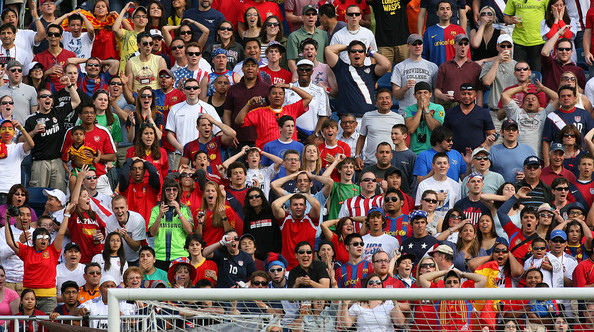
At Saturday's shambolic U.S. National Team game the goal was the fill the stadium with red.

Nike had earlier debut their red national team strip and helped outfit the American's unofficial supporters group, the American Outlaws, with a cool Shepard Fairey designed "Indivisble" collaboration to add to the already red 2011 AO members shirt.

The result? A "Red All Over" supporters section to rival any other behind the goal.

The rest of the stadium, from crowd shots and close ups revealed a similar red wave, but fueled less U.S. fans, but the brighter red of the Spanish National Team and red and blue Spanish side Barcelona's jersey.

Sigh. Here we go again.

In the United States, a nation of immigrants and one of the most diverse countries in the world, American soccer fans are no longer surprised to be outnumbered within their own stadiums. Its one of the reasons the American Outlaws and the Free Beer Movement were founded; to grow the sport here and grow our presence each game day. It's readily conceded that for matches against teams like Mexico and other nearby Central American nations the visitors will turn out in force.

On Saturday, however, the USMNT was betrayed by its own. Americans in Spain jerseys. Americans with Messi's name splashed across the back. Americans in Manchester United jerseys!

Let's play a game. How many DIFFERENT jerseys can you spot?
For high profile matches this is also not uncommon. But it is infuriating. Americans who seem to go out of their way NOT to support their country of birth.

Were many of those people from Spain living in the United States? Yes. Completely acceptable.

Were many of those people of Spanish-decent honoring their heritage? Yes. Also totally fine.

Were many of those people Americans of little connection to Spain or Spanish teams sporting the colors of World Cup, European Cup, and Champion's League winners? Yes. Not OK.

The beauty of the Spanish National Team was on full display on Saturday and the dominance of Barcelona a week earlier at Wembley against Manchester United in the Champion's League Final and we can appreciate the fact that both of these teams are probably the best example of the greatest of soccer in our day and, for many, represent what has brought them to the sport of soccer and created their connect to it.

If this is what soccer IS for you... super. If this is what you want to treat people to for the Free Beer Movement... go for it.

But we just cannot condone wearing those teams to our National Team games.

It isn't something jingoistic or Tea Party-fueled nationalism, but a enduring and deep love for this nation and the desire to see AMERICAN soccer succeed so we don't replicate Saturday's result again and again.

We own loads of soccer jerseys. Many different clubs from around the world. Many different National Teams as well. One from Honduras where we once lived. Another from the Netherlands, our ethnic roots, and even one from Hong Kong where a sister once visited. They are worn with regularity, but NEVER on a U.S. game day.

We get it. America likes winners. Spain and Barca are winners. Here's Sporting News' Brian Straus, post-game in the media zone:


As someone said to us on Twitter, "That kid, if alive in 1980 would have worn a USSR hockey jersey at Lake Placid."

That's the mentality for many soccer fans in America, "Maybe if the U.S. wins a few more games."

Sure this Spain game was a set up, but what else does the National Team have to do for some people?

Isn't qualifying for six straight World Cups good enough?

Paul Caligiuri's 1989 "Shot Heard Round the World" (to qualify the U.S. for its first World Cup in 40 years) didn't get ya?

Didn't our magical run to the 2002 quarterfinals and oh-so-close knock out to eventual finalist Germany grab you?

What about Landon Donovan's stoppage time game winner against Algeria last summer? Really? That didn't do it?

What will do it? Maybe the goal posts (for lack of a better term) keep moving for some soccer fans in America.
__________________________________________________

What is comes down to is really a choice. A choice where, today, right now, we can make an investment in American soccer and not just soccer in America. We've got an opportunity to get in on the ground floor of building American soccer and soccer in America. To invest, to spread, to share, to love through ourselves and through others and to others.

It's not perfect, but it is ours. It still has a long way to go, but as the Preamble of the Constitution states, "In order to form a more perfect union". We're working on it.

Spain and Barcelona and Liverpool and AC Milan are going to be just fine, but Major League Soccer and the U.S. National Team need your support because if American soccer fails.... soccer in America fails.

No more high-profile international friendlies. No more World Football Challenge. No more World Cups in the United States. It all dies.

We're not being dramatic. If Americans can't prove they're hungry for soccer (and watching loads of English Premier League on Fox Soccer doesn't count) then the clubs take their business elsewhere. They chase the China yuan or friendlies in Qatar.

The Free Beer Movement wants everyone to become fans and everyone's path to becoming a soccer fan is different. In the end, though, we want you to become American soccer fans. Even for us our first experience with soccer was Michael Owen and Liverpool, but more crucial to our development was the 1998 Men's World Cup and the 1999 Women's World Cup. Locked. Us. In.

That the natural evolution we're going for. Get into soccer. Get into American soccer. (And, of yeah, do it with beer!)

When the United States National Teams rolls into your town, fold up your other jerseys, and put on the red, white, and blue.

Get the NEW Free Beer Movement "Pint Glass" shirt! Only from Objectivo.com

Thursday, March 18, 2010

De-constructing Stupidity: In Defense of American Soccer

14 comments
Editor's Note: This is the first time we've ever done this (so go easy on us), but we couldn't let this inaccurate, poorly written, and blatantly stupid article just pass under the radar. Too often major media outlets let the columnists take a swing a soccer, sport's whipping boy and run said column as a big "F you" to the American soccer community. Today... we defend this house. The article comes from Alex Beam of the International Herald Tribune and was published in the New York Times on March 18th, 2010. His words in bold, our responses in italics.

This little piece of brilliance is also cross-posted over at the great American soccer site, Match Fit USA.
The World (Minus the U.S.) Cup

If you are a man, you know the feeling. At a party, you encounter a beautiful woman, perhaps a tad exotic. She speaks with a hint of an accent — South American? — and she dresses a notch above the people you hang around with. Is that a Sapphire martini in her hand? You think about approaching her. But in the end, you shy away.

America is that man. The World Cup is the exotic, unattainable object of fascination. The Quadrennial Awkward Date resumes
.

First off, this is just the worst bit of metaphor I've read in a while. Must Read Soccer better save some space for worst writing of the week because we've got a nomination right here. I've written better leads when I wrote for my high school newspaper. Honestly, if America was at that party... America would walk over (being the greatest country in the world) and charm the shit out of that South American? hottie. Case closed. Metaphor over.
It would be great if Americans could embrace the World Cup, because then big U.S. sponsors could make even more money.
Big U.S. sponsors already make a ton of money from the World Cup. Take a look at the sponsors of the upcoming Cup: Coca Cola, McDonald's, Continental, Visa, Castrol, and many more. You don't think they didn't get into the game to grab a slice of the pie? Those are some of the biggest companies in the world. Not to mention Nike who isn't sponsoring the competition, but might as well for how often they'll show up there.
The American audience for the World Cup has increased in past years, but rarely approaches the viewership for red-white-and-blue sporting events. This year’s (admittedly excellent) Super Bowl attracted over 100 million couch potatoes. The mind-blowing, head-butting 2006 Italy-France World Cup final lured 17 million American viewers.
The problem being that when you compare finals head to head, yes, the World Cup comes up short. Too bad the tournament isn't... wait... JUST ONE GAME. So let's multiply 17 million viewers times 64 matches, OK? How about we compare one massive tournament in the U.S. to the World Cup and see how they match up? In 2009 the NCAA basketball championship game between North Carolina and Michigan State garnered 17.6 million viewers. Oh wait! That's almost EXACTLY the same as American views of the World Cup... must be that college basketball hasn't arrived yet in the United States. Oh, and another thing, the 2006 World Cup ratings in the U.S. you cited was a 152 PERCENT increase from 2002 whereas the NCAA tourney finals has seen a decrease over the last five years. You want more? The World Cup final regularly outdraws the NBA Finals and World Series in the U.S.
For Americans, soccer is just not a sport you play hooky for. What American boy hasn’t played sick to watch a World Series baseball game a few times in his life? I feigned many a flu to watch Juan Marichal of the San Francisco Giants pitch against Sandy Koufax of the Los Angeles Dodgers, back when dinosaurs roamed the earth. But I can confidently predict that classrooms will be full, and workplace absenteeism will be at normal levels, when the United States plays its first round matches in South Africa this June.
Soccer is a sport you play hooky for. During the 2002 World Cup in Korea/Japan I faked having to take my little sister to basketball camp every morning so I could show up late to work. I've taken over a week of vacation from my job to travel to both Washington DC to see USA versus Costa Rica on a Wednesday and USA against Honduras in Los Angeles. Those are stories that were repeated by almost every other soccer fan I met there. Those committed to even water polo skip work to watch their sports. Be surprised... watch the work place numbers this year.
Why? For one thing, America has yet to develop a soccer culture. It’s the most popular youth sport in the country — there is lots of “sharing” — but in most surveys, professional soccer ranks 10th or lower in fan interest, after stock car racing and several college sports.
According to this recent Harris poll there is no foundation (other than the author's mind) that soccer falls outside the top ten for fan interest in the sport. In fact, soccer ranks in the top ten while numerous other sports have seen dramatic drops in popularity (i.e. baseball, men's tennis, etc). And what the fuck is that random aside about "there is lots of sharing"? What do you mean by that? What place does that have in this professional journalism writing? Are you against sharing? Is that some frat boy inside joke about soccer?
To indulge some gross stereotypes, white Dads play catch with their sons in their backyards. Black kids play basketball. Hispanic-American kids may play soccer, but there are only one or two of them on the 20-man American roster.
Great now you're engaging in stereotypes to justify your argument. I'm sure that's going to go over real well. Another factual error here as well. The US roster contains 23... TWENTY THREE players. And among those 23 players include such notable Hispanic Americans (which by the way IS NOT the proper way to call Latinos... "Hispanic" implies they are from the island Hispaniola (Haiti and the Dominican Republic) and not from Latin America. I digress... Carlos Bocanegra, Jose Fransisco Torres, Edgar Castillo, Alejandro Bedoya, Jonathan Borenstein (Jewish-Mexican), and Nick Rimando to name a few recent USMNTers. So that's more than "one or two". Again, good research.
For another thing, U.S. soccer just isn’t cool. It’s no accident that the only TV ad I remember from the last World Cup featured the Brazilian soccer team horsing around in the locker room, bouncing a soccer ball off of every conceivable appendage while grooving to samba music.
Did you see what our boys did to the "cool" Brazilians in the Confederations Cup last summer? Black is the new white. USA is the new Brazil.


Where do they get those names, anyway? Dida, Cafu, Kaká, Fred. By comparison, the current U.S. team roster reads like the letterhead of a white-shoe law firm: Evans, Goodson, Findley & Marshall.
Where do I start here? Evans... not on the team. Goodson... maybe. Findley... not if Charlie Davies is back. Marshall... nope. Oh, how about "law-firm" names Onyewu, Bocanegra, Cherundolo, Hejduk, Bedoya, Klejstan, Torres, Edu, and Adu.
Who are you going to fall in love with? Nice white boys from California and the mid-Atlantic states, suburbs, or the funky futbolistas of the favelas?
Sigh. Exhibit A: Clint Dempsey. Grew up rural poor in Nacgodoches, Texas. Had to drop out of soccer so his sister (who died by the way) could play travel tennis. The rest of his team raised money so he could still play with them. How about Freddy Adu (if he ever gets another look), who's single mother immigrated from the Ghana so he and his brother could play soccer in the U.S.? Or maybe Jay DeMerit from Green Bay, Wisconsin who paid his way to a tryout out with a non-league side in England and then was picked up and is now the captain of Watford, a big English club. I'll fall in love with my Yanks.
And it’s not just the Brazilians. The current English national team is a hotbed of wife-and-girlfriend swapping intrigue. I haven’t seen an American footballer on the front page of the New York Post, well, ever.
Maybe you missed it, but the same thing happened over here. The news broke at the same time, but you were probably too busy being entranced by the "sexy" English scandal. John Harkes, back in 1998 slept with fellow USMNTer Eric Wynalda's wife. Harkes was then dropped from the 1998 squad. This was all just revealed, but if there were any mainstream journos following soccer back them you could have easily uncovered it and added to the "intrigue" back then.
Big-time soccer cued up its shot in the U.S. and missed. Football god David Beckham was supposed to save the American game when he joined the Los Angeles Galaxy in 2007, but he never broke through, on the field or in the popular imagination. Not only was he bedeviled by injuries, but his greatest skill — serving parabolic passes from the outside midfield — is one that scoring-obsessed Americans could never appreciate. His wife Victoria’s frenzied attempt to become a celebrity in a town that already had celebrities, thank you, likewise gained little traction.
The only people that said that Beckham was going to "save" American soccer were the people that hoped that soccer in this country dies. It’s a set-up argument. If I said, "the New England Patriots MUST not lose a game this season and win the Super Bowl otherwise football is dead" and then they don't do it... I win. I certainly don't remember anyone in any position of authority, not commissioner Don Garber, the president of the Galaxy, or Beckham himself saying he was here to "save" American soccer. Soccer in America DOES NOT NEED SAVING. It is strong, stable, and growing in this country. Only from pretentious fucks like you maybe who keep looking for the silver bullet to slay the sport here.
The Beautiful People assembled to tout the opening of the David Beckham Soccer Academy in Los Angeles in 2005. When it closed a few months ago, a brief press release did the job.
So what? His flashy, exclusive soccer camp closed. Too bad you mentioned earlier in the article that soccer is the largest youth sport in the nation so I think soccer for kids will be just fine.
Hope springs eternal at ESPN, the network that will broadcast the games to most Americans. On the one hand, ESPN’s vice president of programming Scott Guglielmino allows that if, by some miracle, the American team plays deep into the month-long tournament, that could produce a possible ratings bonanza.
But no matter what, this summer's World Cup WILL BE a "ratings bonanza" because viewership is up across the board for soccer. Face it.... ESPN is doubling down on soccer in the country. They are investing in the English Premier League, Major League Soccer, and even rolling out 3D TV for this summer's Cup. The Worldwide Leader in Sports intends to make soccer in this country.
Just in case, he says the network will be rolling out some “team predictor” Web software that will match fans up to teams whose style of play they might enjoy. “It’s O.K. to root for more than one team,” he says. “We want the non-core fan to buy in and connect with the World Cup.”
That sounds like ... a dating service.
Great another good ol’ boy joke at the expense of soccer. Good one. You got us there.

FUCK YOU. We will win.


Support the Movement. Get the Free Beer Movement T-Shirt. Only from Objectivo.com